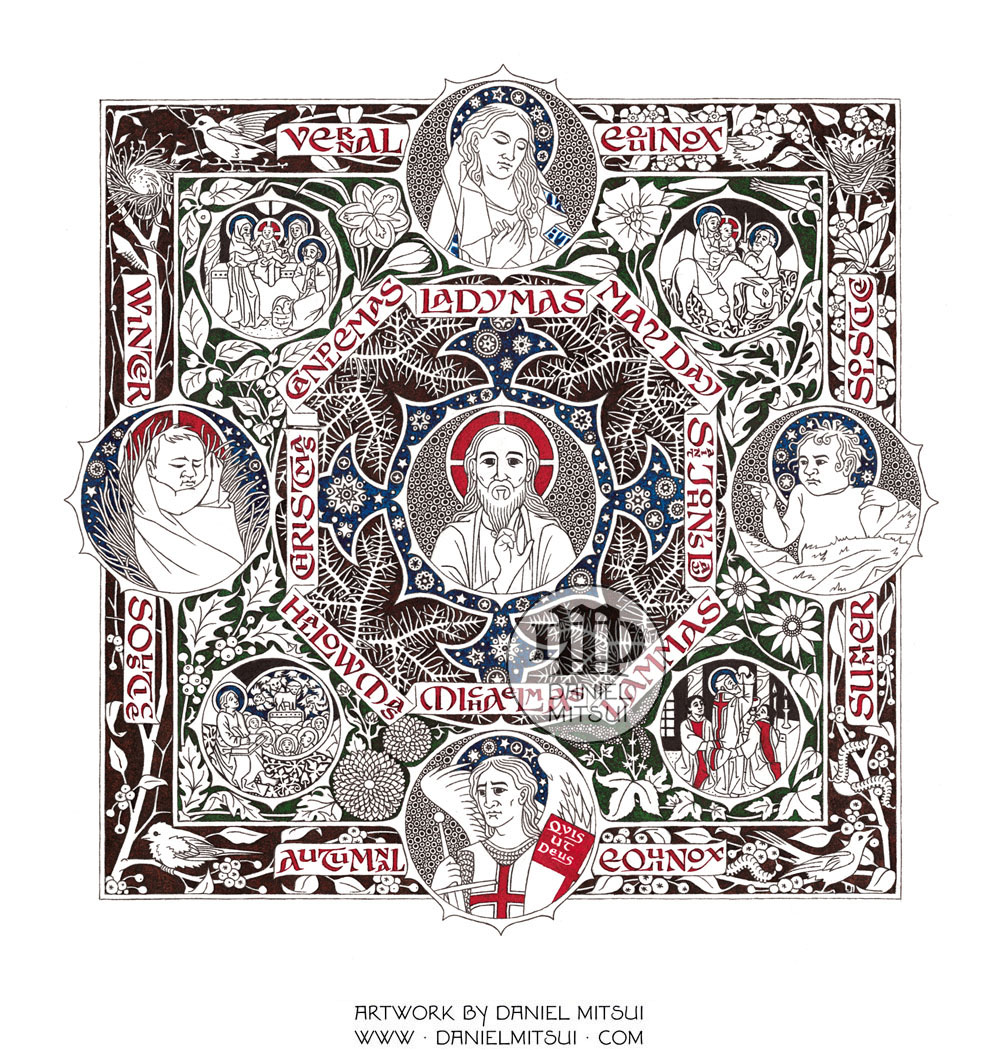
This drawing illustrates a solar calendar, marked by feasts of the Church year that occur on fixed dates, specifically those that correspond to the yearly solstices, equinoxes, and cross-quarter days.
The quarter days are these:
Ladymas, 25 March, the feast of the Annunciation, which is close to the vernal equinox.The correspondence between the liturgical and astronomical events is significant; as John the Baptist said of Jesus Christ: He must increase, but I must decrease. Thus, the days begin to lengthen with the birth of Jesus Christ at the darkest time of the year, and then begin to shorten with the birth of St. John, six months later.
St. John’s Day, 24 June, the feast of the Nativity of the Baptist, which is close to the summer solstice.
Michaelmas, 29 September, the feast of the Archangel, which is close to the autumnal equinox.
Christmas, 25 December, the feast of the Nativity of Jesus Christ, which is close to the winter solstice.
The cross-quarter days, which mark the traditional beginnings of the seasons and occur about halfway between the solstices and equinoxes, are these:
Candlemas, 2 February, the feast of the Presentation in the Temple.In the center I depicted Jesus Christ raising His hand in blessing. His emblem is circular, surrounded by a ring with points that suggest the sun. (The emblems representing the liturgical feasts are also like this.) The central emblem is within a cross, whose outline is filled with stars, to show that the sun (and by metaphor, Jesus Christ the Sun of Justice) is the greatest light in the heavens. Around this, the ornament is composed of branches of an evergree fir tree. This is to say that God never changes, even though the seasons do.
May Day, which is both a feast of St. Joseph and the beginning of a month dedicated to the Virgin Mary. Here I illustrated the Flight onto Egypt, to include the entire Holy Family.
Lammas, at the start of August. Here, I illustrated St. Peter celebrating Mass; this refers both to the feast of St. Peter in Chains, and to the Eucharistic meaning of the loaf-Mass.
Hallowmas, at the start of November, the feast of All Saints. Here, I illustrated St. John the Revelator’s vision of the great multitude, which is read as the lesson at this day’s Mass.
Further out I arranged the emblems corresponding to the eight feasts, whose names are written on a folded ribbon. The ornament between these emblems is composed of plants that berry or blossom at the appropriate times of year. These are, starting at Christmas: wintergreen, crocus, lily, dandelion, black-eyed susan, ragweed, chrysanthemum, and holly. The outer border has ribbons with the names of the astronomical events. It also depicts some of the annual life cycle of a sparrow, a butterfly, and a crabapple tree.
Medium: Drawing; black, red, blue, green, and brown ink on Bristol board
Dimensions: 10" square
Year: 2026
Open-edition giclée prints of this drawing are available. You may use the buttons below to pay via PayPal, debit card, or credit card. Be sure to confirm the shipping address.
|
Actual size art print: $88
|
20" × 20" large print: $176
|
200dpi digital download: $18

|
See this page for additional ordering instructions and general information. If you want to pay via a check or money order, please e-mail me at danielmitsui@danielmitsui.com.
