
This drawing depicts the decollation or beheading of John the Baptist, which is recounted in the Gospel of Matthew:
For Herod had apprehended John and bound him, and put him into prison, because of Herodias, his brother’s wife. For John said to him: It is not lawful for thee to have her. And having a mind to put him to death, he feared the people: because they esteemed him as a prophet. But on Herod’s birthday, the daughter of Herodias danced before them: and pleased Herod. Whereupon he promised with an oath, to give her whatsoever she would ask of him. But she being instructed before by her mother, said: Give me here in a dish the head of John the Baptist. And the king was struck sad: yet because of his oath, and for them that sat with him at table, he commanded it to be given. And he sent, and beheaded John in the prison. And his head was brought in a dish: and it was given to the damsel, and she brought it to her mother.Although the Biblical text does not say that Herodias and Salome were present at the execution, I wanted to include them in the picture, to acknowledge their role in John’s death. An old literary tradition, attested in several medieval Irish poems, asserts that the executioner of John the Baptist was Mog Ruith, a blind druid who studied under Simon Magus. (Later settling in Munster, he became one of the most powerful sorcerers of Ireland, bringing to that land a curse for his part in John’s death.) While this isn’t something I think to be actually true, it did influence my decisions about the headsman’s appearance.
The sword is an executioner’s sword, rather than a battle sword, which is why it is long and squared at the end. Swords of this type were most common in the 16-17th centuries, and often had pious inscriptions on their blades. Here, the sword is inscribed with four Hebrew words: head, tail, palm, and reed. This is a reference to Isaiah 9: Therefore the Lord will cut off from Israel head and tail, branch and rush, in one day.
The inscription on Salome’s silver platter is: The Lord hath hewn asunder the necks of sinners, from Psalm 129. Both inscriptions are intended ironically, as the sword here is being wielded on behalf of unrighteousness and injustice.
The inscription on the background architecture is mostly obscured, but it is from the Book of Samuel, when the people of Israel ask for a King, and Samuel relays to them the warnings of God, listing the ways that a king will abuse his power. This refers to the corruption and injustice of Herod.
In several 15th century paintings of the decollation of the Baptist, I noticed that an acrobat was included in the background. I never was able to figure out what this detail signified, but I thought that I might include it also. Ultimately, there wasn’t room in the composition, but I did use an acrobat for the base of the column at the right of the picture.
The Baptist’s clothing is of course the raiment of camel’s hair and leathern girdle mentioned in the Gospels. I have chosen to connect it to another tradition, an ancient Jewish legend that traces the garments of skin made by God for Adam through subsequent centuries, passing into the possession of Seth, Noah, Ham, Cush, Nimrod, Esau, and Jacob — and eventually the prophet Elijah. While I don’t necessarily consider this tradition deserving of literal belief, I like its symbolism and the way that it connects these figures. Since John the Baptist is a successor and New Testament counterpart to Elijah, I have chosen to make his garment identical to that worn by Elijah in other pictures of the Summula Pictoria.

John the Baptist is one of twelve Biblical figures for whom I have designed a signature carpet, to appear with him throughout the Summula Pictoria. The art historian Volkmar Gantzhorn argued in his book The Christian Oriental Carpet that carpets are traditional indicators of sanctity, like halos for the feet. John’s carpet, like Enoch’s and Elijah’s, includes the words propheta and martyr written in orthogonal letters.
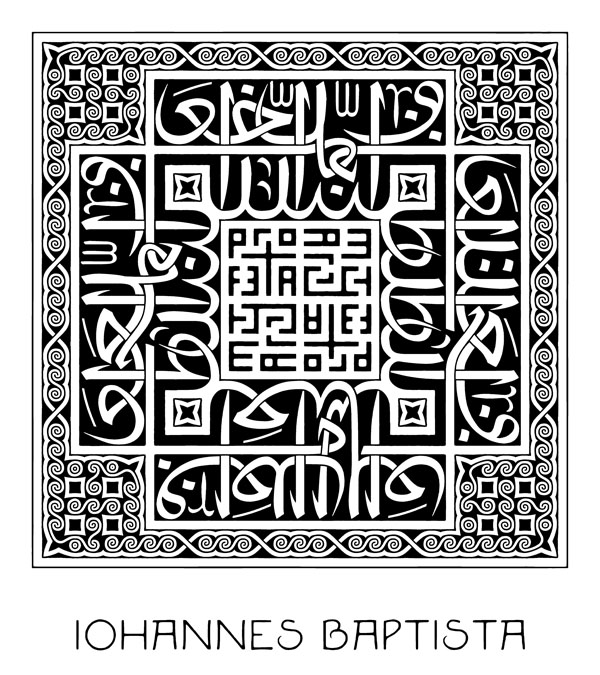
Throughout the Summula Pictoria, I depict halos according to a system that I myself invented. Saints of the Old Testament have silver or lunar halos, whereas saints of the New Testament have golden or solar halos. John’s halo is both gold and silver, solar and lunar, to indicate his unique position between the Old and New Testaments. (Mary is the only other figure I give a gold and silver halo, but hers is gold on the outside and silver on the inside, and the space between is the light blue of the daytime sky, rather than the dark blue of a starry night.)
In all drawings of the Summula Pictoria, I use the translucent calfskin for artistic effect, drawing certain details on the reverse side. These appear more or less distinct depending on how much light is shining through the drawing. Here, those details include background shadows, blood stains on the wood floor, and fossil coral and sea shells in the marble pillars.
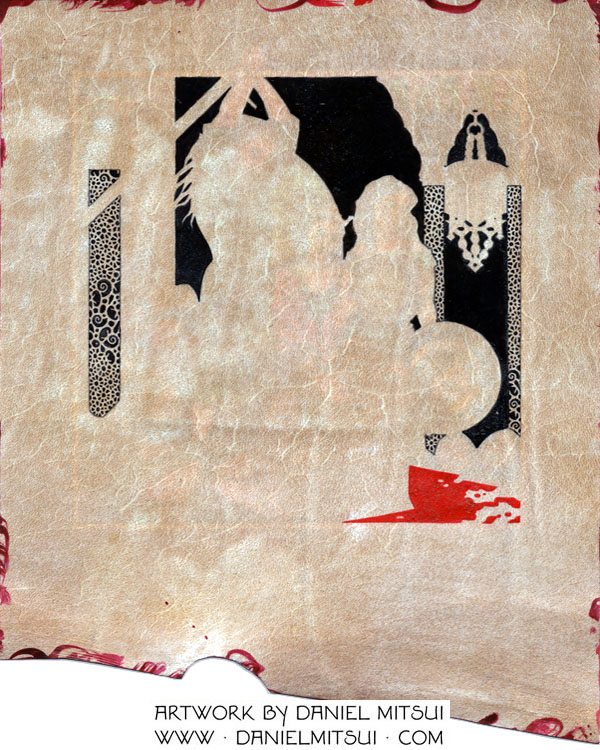
Drawings of the Summula Pictoria that depict martyrdoms of the saints have a red border. I drew on the end of a piece of calfskin, which is why the bottom of the drawing has an irregular edge.
Medium: Drawing, color ink on calfskin vellum
Dimensions: 6" × 6 3/4"
Year: 2024
Open-edition giclée prints of this drawing are available. You may use the buttons below to pay via PayPal, debit card, or credit card. Be sure to confirm the shipping address.
|
Actual size art print: $34
|
13" × 14" large print: $68
|
200dpi digital download: $7

|
See this page for additional ordering instructions and general information. If you want to pay via a check or money order, please e-mail me at danielmitsuiartist@gmail.com.
