
This drawing depicts the fifth day of Creation, as described in the first chapter of the Book of Genesis:
God also said: Let the waters bring forth the creeping creature having life, and the fowl that may fly over the earth under the firmament of heaven. And God created the great whales, and every living and moving creature, which the waters brought forth, according to their kinds, and every winged fowl according to its kind. And God saw that it was good. And He blessed them, saying: Increase and multiply, and fill the waters of the sea: and let the birds be multiplied upon the earth. And the evening and morning were the fifth day.Traditional iconography, through much of the Middle Ages, depicts God the Son, the pre-incarnate Word, as the Creator. This reflects what was said of the Word in the Gospel of John: All things were made by Him: and without Him was made nothing that was made.
I drew Jesus Christ wearing priestly garments. Because the depicted event occurred before His Incarnation, I drew His figure on the opposite side of the translucent calfskin. Sacred artists, perhaps limited by their materials, have for centuries largely avoided the challenge of drawing non-incarnate beings in a distinctive way. My own practice is to draw these figures or emblems on the opposite side of the calfskin, so that their apparent bodies have a ghostly appearance, and are only fully visible when the drawing is held up to light. It is an imperfect solution to an impossible problem, but it is the best idea I have for now.
I have long been fascinated by the account of the six days of Creation given in Genesis, and that way that they proceed in order by dimension: On the first day, by separating day from night, God created a difference of time. On the second, by placing the sky between heaven and earth, He created a vertical order. On the third, by moving the land and the water apart, He created a horizontal order. Over the next three days, this succession (temporal, vertical, horizontal) was repeated, as each dimension was filled with moving things: first, the celestial bodies that mark the days and seasons and years; second, the animals that move vertically (by flying or diving); third, the animals that move horizontally upon the earth, including Man.
For the purpose of this picture, I considered the categories of bird and fish to be defined dimensionally: birds are creatures that fly up into the air, and fish are creatures that swim down into the water. The inspired authors often used this taxonomy based on direction of movement (rather than anatomy): bats are referred to as birds in the Bible, and whales as fish. (There are some exceptions to this: ostriches are referred to as Birds in Leviticus.)
In my drawing, the birds include all kids of flying creatures, including a pelican, a quetzal, an owl, a hummingbird, a pheasant, a crow, and a vulture; as well a bat, a wasp, a butterfly, and a pterosaur. The fish include all kinds of swimming creatures, including a tuna, a shark, a seahorse, a squid, a nautilus, a seat turtle, a sperm whale, an oarfish, an octopus, an umbrella-mouthed gulper eel, and a vampire squid from hell. (That is the name of an actual organism, Vampyroteuthis infernalis.)
The idea of arranging the birds and fish in concentric rings is one I got from Gennady Spirin’s masterfully illustrated picture book Creation.
Of special significance is the pelican at the top center of the drawing, to whose breast God the Son points directly. The pelican is a symbol of God the Son; medieval pictures the Crucifixion and the Resurrection are often juxtaposed with pictures of a pelican. The Corpus Christi hymn Adoro te devote by Thomas Aquinas refers to Jesus as pie pellicane. The medieval bestiaries explain this symbol. A pelican, they said, feeds its dead chicks blood from a self-inflicted wound in its side, thus raising them to life; it is a type of Jesus Christ who gave us eternal life by shedding His blood on the Cross.
Since I do not consider the legend of the pelican’s self-wounding to be literally true, I did not depict it happening in my drawing; nonetheless, I wanted to make a reference to this venerable Christological symbol.
God the Son here stands on a jetty of newly-created land, among a variety of plants. In the far background are some fantastic landforms, based on those in the Garden of Earthly Delights triptych by Hieronymus Bosch. I believe that this triptych, which has caused so much debate among scholars, actually has an easily understood meaning:
Its outer panels depict the world in the midst of Creation, perhaps on the night of the fifth day. The left inner panel depicts the Marriage of Adam and Eve, and the famous center panel is, I am convinced, an icon In Diebus Noe. That is, it depicts the wickedness that prompted the Great Flood.
Bizarre geographic features appear in the outer, left and center panels. While there are strange shapes in all of Bosch’s paintings, the only other place I see mountains like these is in the left panel of the Haywain triptych, which depicts events in the Garden of Eden. I do not think that Bosch was painting weird mountains just for the sake of painting weird mountains, but rather depicting a peculiarly antediluvian geography. He was expressing the idea that the world’s landscape was radically changed by the Great Flood.
Throughout the Summula Pictoria, I model geographic features in the antediluvian world after those painted by Bosch.
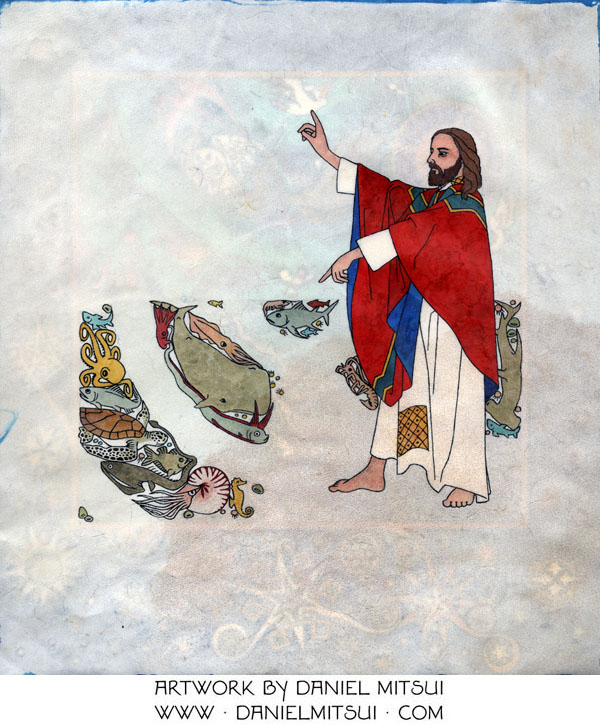
In all drawings of the Summula Pictoria, I use the translucent calfskin for artistic effect, drawing certain details on the reverse side. These appear more or less distinct depending on how much light is shining through the drawing. Here, those details include the fish, so that they look like they are seen through water.
The outer border of the drawing includes a variety of heavenly lights that had just been created on the previous day.
Medium: Drawing, color ink on calfskin vellum
Dimensions: 6" × 6 3/4"
Year: 2022
Open-edition giclée prints of this drawing are available. You may use the buttons below to pay via PayPal, debit card, or credit card. Be sure to confirm the shipping address.
|
Actual size art print: $34
|
13" × 14" large print: $68
|
200dpi digital download: $7

|
See this page for additional ordering instructions and general information. If you want to pay via a check or money order, please e-mail me at danielmitsui@danielmitsui.com.
